The corporate training landscape has changed dramatically. Ten years ago, training was simple: you assigned a course, the employee clicked “Next” until the end, and a certificate was printed. Today, employees demand more. They want learning that feels like browsing Netflix or YouTube—personalized, on-demand, and engaging.
This shift has created confusion for many Learning and Development (L&D) professionals. You are likely facing a dilemma: Do you stick with a traditional Learning Management System (LMS), or do you migrate to a modern Learning Experience Platform (LXP)? Or perhaps, do you need both?
Choosing the wrong platform can be a costly mistake, leading to low engagement rates and wasted budget. In this guide, we will break down the differences, explore the strengths of each, and help you decide the best strategy for 2025.
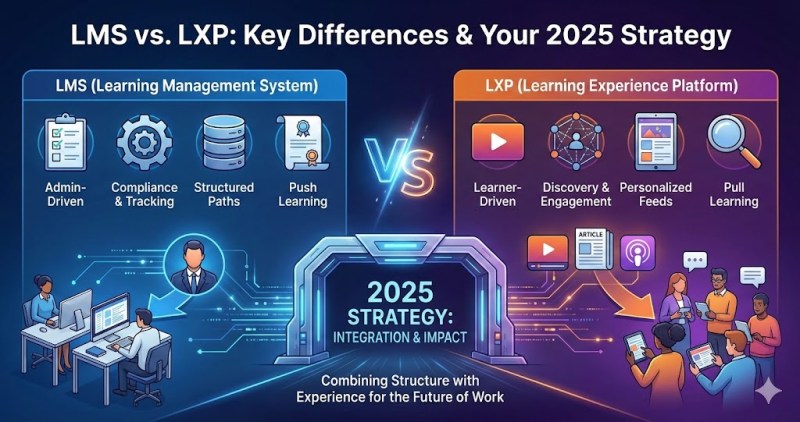
What is a Learning Management System (LMS)?
To understand the difference, we must first define the standard. A Learning Management System (LMS) is software designed primarily for the administrator. Think of it as the foundational infrastructure of your training department.
An LMS allows you to host, deliver, and track training content. It is a “top-down” system where the organization decides what the learner needs to know.
Key Characteristics of an LMS:
- Compliance Focus: It is the best tool for mandatory training (e.g., Cybersecurity awareness, Sexual Harassment prevention, Safety protocols).
- Structured Learning: Courses are organized in a linear path (Module 1 -> Quiz -> Module 2).
- Certification: It automatically issues certificates and tracks expiration dates.
- Reporting: It provides detailed data on who finished the course, how long it took, and their test scores.
If your primary goal is to ensure your company meets legal regulations and internal standards, a Learning Management System is non-negotiable.
What is a Learning Experience Platform (LXP)?
If the LMS is for the administrator, the Learning Experience Platform (LXP) is for the learner.
An LXP focuses on the “user experience” (UX). It aggregates content from various sources—internal courses, external articles, YouTube videos, podcasts, and blogs—and presents them in a highly visual, personalized interface.
Key Characteristics of an LXP:
- Discovery Focus: It uses AI to recommend content based on the user’s skills, interests, and past behavior (similar to how Netflix recommends movies).
- Social Learning: Users can share content, comment on it, and create their own playlists to share with peers.
- User-Generated Content (UGC): Subject Matter Experts (SMEs) within your company can easily upload their own tips or videos.
- Skill-Based: The focus is often on upskilling and professional development rather than compliance.
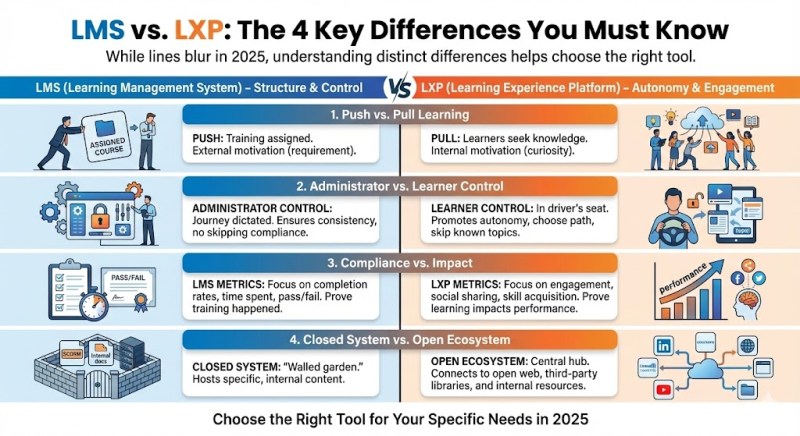
LMS vs. LXP: The 4 Key Differences You Must Know
While the lines between these two technologies are blurring in 2025, distinct differences remain. Understanding these will help you choose the right tool for your specific needs.
1. Push vs. Pull Learning
- LMS (Push): Training is “pushed” to the learner. You are assigned a course because you have to take it. The motivation is often external (requirement).
- LXP (Pull): Learning is “pulled” by the learner. They visit the platform because they want to learn something new or solve a specific problem. The motivation is internal (curiosity).
2. Administrator vs. Learner Control
In a Learning Management System, the administrator controls the journey. You cannot skip a compliance module just because you feel like it. The system ensures control and consistency.
In an LXP, the learner is in the driver’s seat. They can choose to watch a video, read an article, or skip a topic entirely if they already know it. It promotes autonomy.
3. Compliance vs. Impact
- LMS Metrics: Focus on completion rates, time spent, and pass/fail status. The goal is to prove that training happened.
- LXP Metrics: Focus on engagement, social sharing, and skill acquisition. The goal is to prove that learning is impacting performance.
4. Closed System vs. Open Ecosystem
An LMS typically hosts content created specifically for that system (usually SCORM packages). It is a “walled garden.”
An LXP is an open ecosystem. It connects to the open web, third-party libraries (like LinkedIn Learning or Coursera), and internal resources, bringing everything into one central hub.
The Content Gap: Why the Platform is Only Half the Battle
Here is a critical insight that many organizations overlook: Buying the best LMS or LXP will not save you if your content is boring.
You can have the most expensive, AI-driven LXP in the world, but if the content you upload is a static PDF or a boring 60-minute video lecture, your employees will tune out. To make these platforms work, you need interactive, engaging content.
Traditionally, creating high-quality eLearning meant buying expensive desktop elearning software, installing it on a powerful computer, and enduring a steep learning curve. This slows down the entire training process. In 2025, you need agility. You need to create and deploy content instantly, from anywhere.
Agile Content Creation with uPresenter: The All-in-One Cloud Solution
To keep up with the demands of modern learners and the speed of business, you need a tool that is as flexible as your strategy. This is where uPresenter enters the picture.
uPresenter is a modern, cloud-based eLearning authoring platform. It eliminates the need for heavy desktop software, allowing your team to create, edit, and publish interactive courses directly through a web browser.
But uPresenter is more than just an authoring tool; it uniquely bridges the gap between content creation and delivery by offering integrated LMS features.
Why uPresenter Fits Your 2025 Strategy:
1. Cloud-Based Agility (Create Anywhere, Anytime)
Forget about IT requests to install software or being tied to a specific office computer. With uPresenter, your instructional designers and Subject Matter Experts can build courses from any device with an internet connection. This enables true collaboration and rapid content updates.
2. Powerful Interactivity without Coding
Engaging learners requires more than just reading text. uPresenter allows you to easily build complex interactive elements. You can create varied question types (quizzes, drag-and-drop, fill-in-the-blanks) to test knowledge retention effectively, ensuring your content isn’t just passive consumption.
3. Built-in LMS Capabilities for Rapid Deployment
This is a game-changer for many organizations. uPresenter is not just for creating content; you can also use it to deliver training.
- Direct Delivery: If you don’t have a large corporate LMS, or need to deploy a quick training module to a specific group outside your main system, you can assign courses and track learner progress directly within uPresenter.
- Universal Compatibility: If you do have an existing Learning Management System or LXP, uPresenter exports perfectly compliant xAPI packages that will run smoothly on your main platform.
3 Unique Selling Points (USPs) of uPresenter:
- No Installation Required: 100% web-based. Log in and start creating immediately.
- All-in-One Simplicity: Write content, design interactions, and track learner results in one single platform.
- Rapid Authoring: Intuitive interface designed for speed, allowing you to push out timely training without long development cycles.
Which Should You Choose in 2025?
Now that we understand the platforms and the agile content tools available, what is the verdict?
- Choose an LMS if: Your primary need is compliance, regulatory training, onboarding, and tracking certifications for a large workforce.
- Choose an LXP if: You already have compliance covered and want to build a culture of continuous, self-directed learning and knowledge sharing.
- The Hybrid Approach: In 2025, most successful companies use both—an LMS for required training and an LXP for the user experience.
However, the golden rule remains: Regardless of the platform you choose, you need an agile way to create engaging content.
Conclusion
The debate between LMS and LXP ultimately comes down to your organizational goals: Control vs. Autonomy, Compliance vs. Curiosity.
Don’t let complex technology slow you down. A platform is only as good as the learning material it hosts. To succeed in 2025, you need the flexibility to create high-quality, interactive content quickly and deploy it easily.
 Elearning Supporter
Leave a comment